Thursday, July 4, 2013

Exploring a Tennessee Creek

Exploring a Tennessee Creek

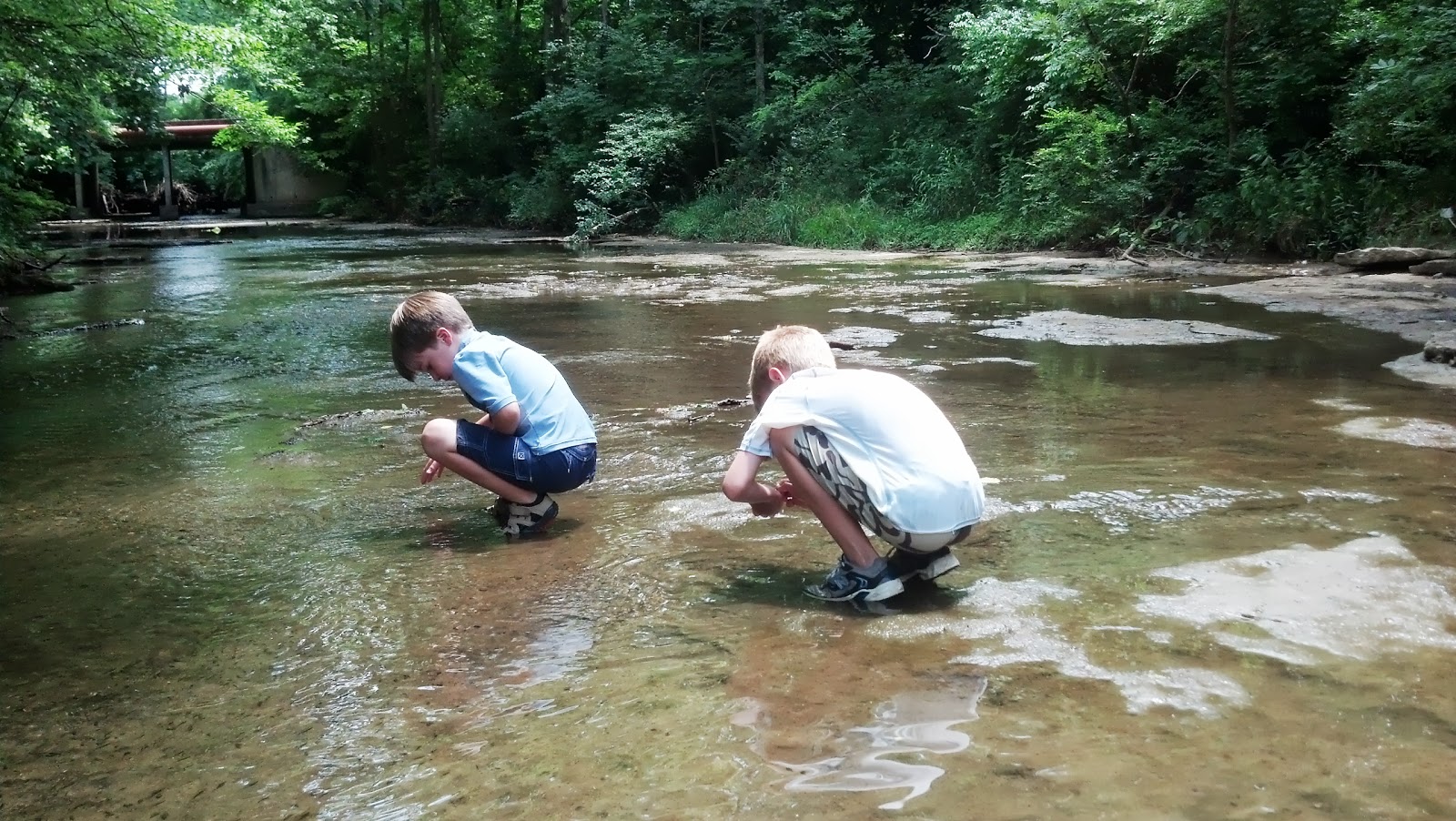
I spent a nice late June afternoon exploring a creek with Blaine and Drake near their home in Nashville, Tennessee.  Although they are city raised, they do appreciate the opportunity to spend some time with nature.
   I don't completely understand the geology of the area.  Obviously, the glaciers never reached this far south.  The creek bottom is rock and the you can sense that the rocks that the creek flows over are old.


They found the rare "deep" spot


Searching for critters
We saw lots of fresh water snails, and guppies of various sizes (an inch to 3-4 inches), a crawdad, and a 9-10 water snake of some variety.

A delightful afternoon and I'm looking forward to more explorations.

Sunday, June 9, 2013

Shiloh


   "Shiloh"   A beautiful sounding word, comes from the Hebrew bible, it was the name of a city that had been a gathering place of worship for the Jewish tribes of Judea before the building of Jerusalem. It is no wonder then that Shiloh has been given to other gathering places, towns in Ohio, Florida, Illinois, and  Pennsylvania and groups and churches including a remote church in southern Tennessee near Pittsburg Landing on the Tennessee river. On April 6; 7th in 1862, Shiloh Church in Tennessee was a gathering place for nearly 100,000 Union and Confederate troops that fought in one the bloodiest battles in the US Civil War.

  The Shiloh National Military Park is located in far southern Tennessee, only 12 miles from the state of Mississippi and near the small Tennessee towns of Grump, Savannah, and Adamsville.  The battle site was one of the first 5 civil war battlefields designated for preservation in the 1890's.  The visitor's center is small but informative with a short film and civil war artifacts and a well maintained cemetery of mainly the Union dead now overlooks the Tennessee River.

  The battlefield borders the Tennessee river which played a significant role in the battle.  The river is 100 yards wide today; but with the TVA, it is probably a different looking river now than in 1862.   The battle site park incompasses hundreds of acres, but is not the total original battlefield.  When you think the engagement involved nearly 100 thousand men, the battle field is relatively small.  I was immediately struck by the number of monuments erected near the park entrance and scattered throughout the park.  Monuments erected by states and the federal government to honor the contributions of the soldiers from both sides that fought there.  Just finding and reading all of the monuments would take a long time.

The park has done an excellent job of laying out the different phases and parts of the battle that essentially covered two days of attacks, retreats, and counterattacks by various elements of each of the armies. The geographic areas are labeled, regiments & battalions are identified, positions of artillery are given with actual cannons in place.  You can easily visualize the movement of the troops over those two days.

You can drive through parts of the battlefield and see the highlights, although walking trails are also scattered throughout the park.

I was surprised by the number of mid-westerners (Iowa, Minnesota, Michigan, Missouri,) that made up Grant's Army of Tennessee.  The Army of Ohio joined the battle on the second day; so even more mid-westerners fought there.

Because  no major city or highway is located near the park, the area is quiet and peaceful.  Areas of timber are interspersed with open fields. A variety of birds and squirrels now make the park their home and the solitude of the area makes it a bit hard to grasp the sound, confusion, and terror as the clash of two armies each numbering over 40,000 soldiers over two days that resulted in over 23,000 casualties, including over 3500 men killed and 16,000 wounded.  The battle had political and military implications that rippled through the rest of the war and afterwards.


Friday, May 17, 2013

Returning the School Car


A sure sign for me of the end of another school year at the University of Northern Iowa is the returning of the school car to the UNI campus.  Although paperwork and other end of the year tasks will continue to be done over the next two weeks, returning the car is a important symbol that another year is done.

Maybe it's even more getting the car ready to turn in.  A school car used for 10 months by one person means that the car becomes a mobile office.  Parts of it takes on the resemblance to my work desk at home; random piles, layers of importance, a mix of items waiting to be thrown away and items that are critical to the job and can not be lost.

The trunk has two large plastic containers that include extra handbooks, observations sheets, note pads, random professional books. One or two grocery sacks that have open packages of napkins and throwaway bowls and plastic silverware are left over from the end of the previous semester's ice cream celebration.

By the end of the year, the car ends up with an umberalla or two, a snow scraper, and a small hand towel used to cover my lap to catch crumbs and to wipe fingers from the many snacks eaten on the go.  Of course, the floor and areas around the seat contain lots of evidence of my eating on the go. I wonder if the garage cleaning crew can track each of our favorite snacks from the stains and crumbs left behind after 10 months.

Turning in the car, the credit card and reporting the mileage driven during the year (9,871 miles), are the final steps of the process.  It will be about three months before I reverse the process and begin again.


Monday, September 10, 2012

2012 Summer Reading

Summer 2012 reading

One of my gauges of a summer are the number and quality of books I've been able to read.  The summer of 2012 was an outstanding one for the quantity of books, maybe the quality was a bit down.

A Walk Across the Sun
   A debut novel, set mainly in India.  Enjoyed the read.
 TheWidower's Tale Jullia Glass
  My daughter's recommendation.  May not have read it otherwise; but enjoyed the story.

 Three Seconds Anders Roslund and Borge Hellstrom
  A Swedish novel, well crafted, a thriller

 Blood Safari Deon Meyer
  OK

 Blackout John Lawton
     Set in England during Battle of Britain.  Mystery novel in a historical context
.
 The Black Echo Michael Connelly
  Michael Connelly

 Swamplandia Karen Russell
  A finalist of Pulitzer prize in literature; but not sure why.  Started well, but disappointed in last half.

 Cutting for Stone Abraham Verghese
   Liked this novel a lot,

Catching Fire  Suzanna Collins
  The second book of the Mockingjay series.  The second book

Killing the Blues  Michael Brandman
   I like the Jessie Stone character created by the Robert S. Parker

 Agent 6  Tom Rob Smith
   Mystery set in cold-war Russia.  Liked the character and the setting

Siro  David Ignatius
   Ignatius writes tight, well crafted novels with international settings and intrique.

The Increment  David Ignatius
  See above

The Litigators  John Grisham
   Grisham weaves a good story.

Nightwoods Charles Frazier
   A different novel than I expected from Frazier, liked the novel

Buried Prey  John Sandford
  Sandford is one of my guilty pleasures, enjoy all of the "prey" series.

The Blind Spy  Alex Dryden
   International thriller/spy book.  a quick read

Steve Jobs Walter Isaacson
   A biographical revealing that I generally found interesting.

Boomerang Michael Lewis
   Michael Lewis writes in a clear understand fashion of complex topics; this time it's the European Monetary crisis that some European countries find themselves.  A bit scary.

In the Garden of Beasts  Erik Larson
  Non-fiction focusing on two people from Germany as the rise of Hitler and Nazis.  The American ambassador to Germany and his daughter.  Fascinating.

#3 Saxon Tales  Bernard Cromwell
  Another guilty pleasure,  I'm reading two of Cromwell series of historical novels.

The Tiger's Wife  Tea Obrent
  Not what I was expecting at all, really two stories in one

SUPERFreakonomics  Steven D. Levitt and Stephen J. Dubner
  Loved reading about their theories of micro-economics and the illustrations enhanced the text.

Maphead  Ken Jennings
  If you love Geography, you'll appreciate this book by someone else who loves geography.  Ken Jennings is the all time money winner from game show, Jeopardy.  Thanks, Theresa for suggesting the book.

The Entitled Frank DeFord
  I don't read many sports novel.  But I admire the articles of DeFord, so took a chance.  A good read, and more than a sports novel.

The Snowman  Jo Nesbit
  This one kept me guessing

Cloud Atlas  David Mitchell
 One of the most unique books I've read.  Took me a while to get into it (two years), but finally kept at it until I was hooked.  They're making a movie of this?   Thanks, Brad.

The Orchardist  Amanda Coplin
   A well crafted, well written novel.  Heard about the book on PBS, but part of the intrique was the story was set in Central Washington and included towns and areas that I've visited often.

Actually, had a lot of other books on my "read list", that still remain there.  Waiting for the next holiday/vacation!

Monday, June 25, 2012

Memories of my father

Father's Day, 2012

Although I don't need a reason, Father's Day provided an opportunity for some reflections on my father, Tom Blaine.

I can remember that as a very young kid and I'd ask him what he was doing, his answer was "Flying a Kite".


My youth impression of dad was he was a humorless man; maybe that's why I can remember the first time I heard him tell a "joke'.  We were at a church potluck and I heard dad say to someone  "Pass the Moo juice".


As a young kid, I was never really aware of family finances; now I realize that raising three children on a postal worker's salary was probably a challenge, which is why he had different part time jobs.   For a while he worked at a postal sub-station that was located at Brady's pharmacy on the corner of Cherry St. and Simmons St.  He mainly worked in the evenings.  He was working the night the Galesburg Post Office burned down (1958), and he called home shortly after the first started. Even though it was night,  Mom took the three of us kids downtown, and we watched the library building consumed by fire while sitting on the front steps of the Central Congregational Church.

A summer job that dad always worked during one of his vacation weeks was at the the Knox County Fair.  One summer when I was maybe 12,  he took me to the fair for the whole day that he worked selling parking lot tickets.  While he worked, I had free reign to wander the fair grounds and the displays.  I just had to stop in and see him periodically.  At night we went to the stock car races.  It was certainly took  a lot of glitter out of going to any fair in the future.

Another part time job that he had was that he would go up to Chicago and drive back new cars for a dealership in town.  This again provided me a special experience when I accompanied on one trip.  We rode the train up, took a cab over to the downtown car dealership  and drove the car back.  The train trip up was special, and I had never ridden in a cab before and then the drive back to Galesburg.

Dad was a reader.  But his favorite read was the Condensed Books put out by Reader's Digest.  He subscribed to the Reader's Digest magazine, and we also got the monthly condensed books.  He was the speller in the family; if any of us kids needed to know how to spell anything, we'd ask dad.  Clearly the spelling gene was one that I didn't inherit.

He's been gone 10 plus years now, but a parent's influence never dies.


Tuesday, June 19, 2012

Meet me in St Louis

We couldn't get together for a family gathering over the holidays, so with  school schedules, work schedules and personal  schedules, the best time was the first week-end in June. We decided on St. Louis as a gathering place since it was centrally located and most of us could drive there.
I got to meet the newest addition to the family, George.  The siblings and the cousins had a chance to spend some time together; and Alice and I got to spend time with them all.


Blaine helping to prepare the bread for spaghetti
 one evening dinner


A trip to the St. Louis Zoo


I hung out with George by the pool

Blaine, Jensen and Drake slowing down for Popsicles 

At the Arch
Theresa, George, Allison, Dave, Blaine, Erin, Drake, Marshall, Alice, Jensen, Tom 

The Grandboys
Drake(6), Blaine (8), George (5 months), Jensen (2 1/2)


It's so great to get all together, but it's always too short of time.   Maybe Nashville in December and Maui in March 2013?

Sunday, June 17, 2012

Spring Road Trip 2012

For our spring road trip we decided to squeeze in a few days between week-ends in Nashville for a quick trip to the Florida panhandle. We had never been in that area; it looked like a doable road trip for the limited time we had, and I was anxious to see some sand and surf. But knowing that we were heading to Florida during a traditional spring break week, I was anxious to find a spot that wasn't going to be full of college students-being college students. The destination we chose was Apalachicola, FL; on the Florida panhandle coast, east of Panama City and south/west of Tallahassee. A small town, known more for its fishing and oysters than casinos and night life. Alice got busy and found a bed and breakfast (http://www.coombshouseinn.com/) available for a couple of nights and we were set.


On our trip town we stayed at a Bed and Breakfast in which is in far southern Alabama. A classic, Victorian home; high ceilings, old wood floors, a bed that you had to climb into and a sinful breakfast.

 As advertised, we found Apalachicola a small, pleasant town. A small area of shops and restaurants, lots of sea food available, although neither Alice or I are fond of oysters, the seafood the area is known for.


We spent two different days exploring the area with a day trip to St Joseph Peninsula State Park and a day trip to St. George Island.

We even saw an alligator along side the road as we drove along.


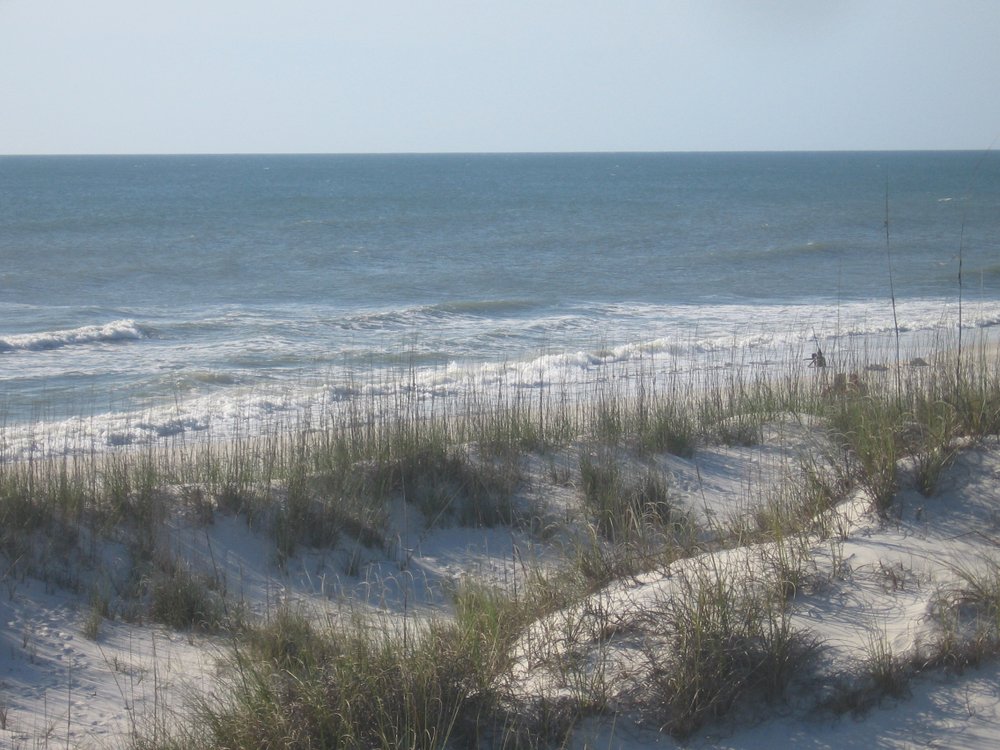
The water was cool, the sand was white and fine, a strong on shore breeze blew most of the time we were there.


Overall, a good quick road trip to begin our travels for the 2012 year.

Tuesday, April 17, 2012

Only 90% left

Last October I began a serious effort to lose some weight. Specifically, I set a goal to lose 25 lbs. The motivation behind this decision was pretty basic. One part vanity; recent pictures from our trip to Hawaii were very unflattering; one part was the recognition that the extra weight was limiting my life style, last summer I couldn't complete a high altitude mountain climb and carrying extra weight was a contributing fact; but a big part of my motivation was health. Blood pressure medicine, high cholesterol medicine, daily glucose checks (no meds yet, but a matter of time). Some of those health issues are part of my DNA, but all of them are made worse by being over weight.

I had actually tried losing weight for the last year, but with little success. I'd try to make better choices and exercise more; but couldn't lose more than 10 lbs. After reading a number of articles about calorie reduction, I decided to adopt that model. A tool that I found to help me was WebMD (http://www.webmd.com/)where you can set up an plan with your weight loss goal and you can track your daily food intake. There are many sites that do this; but one thing I liked about the WebMD was that it sent a daily email reminder to log your food intake for the day. That was helpful for me particularly at the beginning.


Although the WebMD plan suggested a daily plan of 500 calories below recommended daily usage, I personally chose to set a daily goal of 1200 to 1500 calories a day. Initially, I had trouble reaching my goal, but as I tracked my individual meal and food choices, I started to have a much better picture of the calories of my favorite foods (and former favorite foods) and a better picture of portion control.

All the things that any article says about weight loss came true for me: eating more fruits and vegetables (healthy food, fewer calories), smaller portions, certain foods that you just avoid,being honest about the foods you eat and the snacks you have. Exercise certainly helped, particularly after losing 10-15 lbs, it was easier to exercise which meant I could exercise more.

Finally in early March I met my goal of losing 25 lbs, which was 10% weight loss of my beginning weight. More importantly, My trip to the doctor was very encouraging. My blood work looked very good; the doctor took me off all medications!!

So even though I'm only 90% of my self, I feel pretty good. Officially, I'm still overweight, so My goal now is to lose 10 more lb.

Sunday, November 20, 2011

"You don't need a weatherman to know which way the wind blows"

If anyone needs another example of how our government is controlled by lobbyists and those with money, you only need to consider Congress's action to consider pizza as a vegetable for the purpose of the school lunch program.

When common sense is replaced by profit margin and the influence of corporate money, then it signals that, as Americans, we are in trouble.

Wednesday, July 27, 2011

The Oregon Coast

Many mid-westerners are not familiar with the Oregon coast. It's a great natural resource as we found from our stay at Ona Beach.

The Oregon coastal mountains rise just a short distance (2 to 10 miles) from the coast. The mountains help protect the coast from some of the inland summer heat and, along with the sea, contribute to the weather which in summer is fairly comfortable, but can create some fog and overcast mornings. The beaches are completely public, and state parks and beach accesses are common along the coast.

The coast scenery does vary, but it's always beautiful. Highway 101 is never far from the coast, so driving on the highway is very pleasant. But the coast line is best experienced on foot walking on the beaches. The water is cold, so that limits some water activities.


Oregon Sand Dunes


Heceta Head Lighthouse


Wide flat beaches near Ona State Park


Sea stacks near Cannon City


Alice walking the beaches: just like in Hawaii, her head is always down looking for seashells.


Traffic can be slowed by the volume of cars in places and the slowest drive we had was from Portland to Seattle on a Sunday afternoon, choked with people returning from a week-end along the Oregon coast. A great place to visit and vacation.

Reminiscing on a Great Adventure

41 years ago Dave Hicks and I shared an adventure that was probably one of the greatest adventure of my life.

First, in my vernacular, any experience that is outside of the "normal" and has an element of risk that afterwards leaves me with memories (hopefully all positives) that I recall for a long time is an adventure. A pretty broad definition, but it works for me.

Dave and I at Newport, OR, summer 2011.


Back in the summer of 1970 we were working summer jobs in the Burg between our jr. and senior years in college. As a break before heading back to school, we decided to head out west.

In a nutshell, we hopped a freight train in Aurora, IL, and rode it to Whitefish, MT. From there we hitchhiked to Baniff, Canada where we hiked and hung-out for a while. I then hitchhiked down to Washington and Dave hitchhiked and rode trains back to Ill.

That short description doesn't do justice to all of the mini-adventures we had along the way: getting caught by yard bulls in the train yards of St. Paul;having our train car set off in a train yard and losing the rest of the train in Minot, ND; running through a wheat field in Montana to buy beer while the train was on a side track waiting for another train to pass; illegally entering Canada; running out of money in Baniff and having a friend wire some to us; Sharing a box car with some real hobos who taught us the finer points of sleeping in a box car (don't sleep long ways with the car, sleep cross ways; it's safer if the train suddenly stops). After we separated and I was in Washington, I had the opportunity to work fighting a forest fire for a few days. The job helped pay for my flight back home. The scenery and other imagines from the trip are still very vivid for me.

The experience was a life-changer. My self-image was always different after that trip. Although when Dave and I do get together now, we seldom reference that trip in our conversations, the experiences will always be a bond we share.

Friday, July 22, 2011

Two Beautiful Lakes

We visited two beautiful lakes within a couple of days of each other this week. Lake Tahoe in Calif/Nevada and Crater Lake in Oregon.


Lake Tahoe sits on the border of California and Nevada. The largest Alpine lake in North America. 21 miles long, 16,000 ft deep.


Crater Lake from Rim Village

Crater Lake formed in the calderon after Mt. Mazama blew its top over 7,000 years ago.


Crater Lake is approx. 1,000 feet below the rim, 6 miles across, 19,000 ft at its deepest point. The blue of the lake is amazing and difficult to capture on film.


Lake Tahoe is a recreation area; casinos (in Nevada), marinas, vacation homes, hotels, restaurants, golf courses, ski areas, etc.

Crater Lake is a national park. Limited lodging and areas to eat in the park.

Two areas I always wanted to see, checked off in a matter of days. Of the two, Lake Tahoe is where I'd like to go back to again.

Thursday, July 21, 2011

Blue Highways

William Least Heat Moon wrote a travel book in 1982 entitled Blue Highways. It chronicles his journey around America as he drove on two lane roads which, in the old Rand-McNally road atlas, were blue. He often stopped at small town cafes and wrote about the conversations with the people he met. It's an enjoyable read and provides insight in to small town America nearly 30 years ago.

From the Mississippi to the west coast the interstate system is primarily east/west. Because of the zig-zagging in our travels, we've had many opportunities to travel on two lane highways on this trip. We've enjoyed the solitude and scenery of the countryside.

Wednesday we had our own "blue highways" experience in Canby, CA, a town of just over 300 people on highway 299 in the north east corner of California. Needing a break we stopped in at the Canby Hotel, Restaurant, and Saloon. They could have added pool hall, because it had that too; all separate areas in a small, very old building. The place had many antique lamps and pictures, the "lobby" of the hotel was overstuffed chairs that you got to by walking through the saloon. The waitress and cook were nice, older ladies who cooked a great hamburger.

We talked about the Canby Hotel, Restaurant and Saloon the rest of the day.

Wednesday, July 20, 2011

Independence Rock, Wy

Our drive out of Casper, Wy, took us by Independence Rock. Independence Rock is a large, hump of a rock that sits along the old Oregon Trail and California Trail, and served as a half way point from the jump off point along the Missouri and the west coast. Emigrants would hope to reach the points by Independence Day signaling that they would probably make it over all mountains before the winter snows.

Around the rock some settlers carved their names and dates in the rock. You can walk around the rock or climb up the rock and find names etched in the granite.

"Texting" in the mid-1800.s


Only a history nerd might be excited about this; but it was neat to think about the tens of thousands of emigrants who moved along the Oregon and California Trails over 150 years ago. The depression in the ground where the trail went is visible. Some travelers needed to record their passing for whatever reason and we can still see that record of their passing today.

The next day we drove through the salt flats west of Salt Lake City and then again west of Reno, NV. Interestingly, many people used black rocks and wrote out their initials in the white salt basins. Don't think those will last 150 years, but the need to leave a mark on the natural world is still alive.

Monday, July 18, 2011

Black Hills

As we prepared for our trip and told people we would be stopping at the Black Hills, many shared that their own trip to the Black Hills had been one of their best vacations. We've certainly enjoyed our stay. The greenness and topography of the Black Hills contrasts with the high, dry plains to the east and contributes to its wonder. We stayed at the Peregrine Pointe B & B , which was secluded and very comfortable; I could have easily just spent hours sitting on their decks enjoying the solitude of the countryside. The conversation around the breakfast table was always interesting as guests exchanged activities they had done, places they had dinner, or past experiences traveling in the US and abroad.


Some areas of the Black Hills are a bit too commercialized (Keystone) for me, but there are plenty of attractions that would interest a family with kids. The scenery is stunning but can be difficult to take it all in when driving in a car. I can see why people with convertibles and riders on motorcycles are so prevalent (and the Sturgis Harley Rally is still two weeks away).

We did stop at Mount Rushmore. An impressive piece of sculpture and engineering; but, not wanting to be unpatriotic, I'm not sure if carving faces on a mountain side added anything to the natural beauty of the area. But it is a huge tourist attraction and enjoyed by many families.


We drove through the wildlife loop road of Custer State Park and saw only a group of burros who were panhandling from the cars that they had blocked on the road. As we got near the end of the road, we saw a nice herd of bison.

One was nice enough to come over and pose for us.

As we left the Black Hills, we stopped at Devils Tower in Wyoming.

An astounding geological feature. Even more impressive in person than any picture or movie can capture.

Now we have three stops at different places as we work our way to Oregon.

Wednesday, July 13, 2011

Road Trip to Washington: 2011 version

As part of our 40th wedding anniversary, Alice and I are making another road trip out to Washington.

This is actually the third similar road trip to Washington we've taken together. In 1972, with our friends Don and Cindy, we bought a rather ugly green van, put a rug down in the back, threw in a couch, and, with two dogs, headed west. We actually spent our first anniversary in that van as we traveled through the plains. We eventually made our way to Manson, Wa; where my uncle found us jobs picking apples with a grower in the area.

Just over 20 years later we made another road trip to the Washington; this time with our kids in our Toyota van. We visited many of the same spots along the way before arriving in Manson. One thing that really stands out about that trip was that Marshall could drive; so it was nice to sit in the back and let him do his share of the driving.

Now 39 years after Alice and I made that first road trip together, we're heading out again. No camping on this trip,though; we have hotels and B & B's reserved out and back.

This will actually be my fourth road trip to Washington. My parents made a similar road trip when I was 18 months old and my sister was 3 1/2. But I only have a few photos of that trip, no memories.

But the idea of taking a road trip to Washington to visit relatives began much earlier. I have a photo album that my dad made after he and his brother and friends made a similar trip in 1937. I can't imagine what the roads and conditions must have been like as they traveled out to Washington.

The tradition continues.

Wednesday, June 29, 2011

Books in the Digital Age

As an avid reader, the introduction of books in digital form a few years ago was naturally appealing. The initial cost of an e-reader and the knowledge that future generations of e-readers would only get better meant that I could put off buying one for a few years. I read the reviews and monitored the popularity of various e-readers, but I wondered if I'd find reading a book on an e-reader as satisfying as reading a traditional book.

I was actually close to making a decision to buy an e-reader when I was given one for a birthday present. Now that I've had a few months of using it, I've got some initial thoughts about reading a traditional book vs. reading an e-book.

On the most fundamental level, I've found that reading a book on an digital device and reading a book in a traditional published form are equal. I can enjoy (or not enjoy) reading the story on either format; my response to the writing, the author's words, the message of the story is the same regardless of how I read it.

I like my e-reader and the efficiency of buying books on-line. The fact that I can carry many titles around in a thin, light e-reader is an attractive bonus. It's nice to be able to increase the text size and take a little stress off the eyes. (It's easier to adjust the text size than the length of my arms) The e-reader automatically remembers where I stopped reading; no more folded-over corners as bookmarks or losing my place because the scrap of paper I had used had fallen out.

But other aspects of digital books are different than a traditional book.

Going to a book store, whether it is a mega-chain like Barnes and Noble or an independent book store located in a small store, is a shopping experience that isn't possible with e-books. Being able to physically wander through the store and peruse titles-finding books that you might not have considered except the title or cover caught your eye; looking at other related reading matter the bookstore has to offer is a very different experience for me than looking on-line for a book. Stores that sell e-books only exist in the virtual world of the internet. When shopping for a title to download to my e-reader, I tend to go on-line and have a specific book that I'm looking for. It's harder to pick up an electronic book and read the cover and skim a few pages trying to decide to buy it. I know some on-line stores have tried to mimic this browsing experience, but I haven't found it nearly as enjoyable as wandering through a real book store.

The cost of an e-book is less than a traditional book when they first go on sale. But not as much as one might think. Also, e-books are always the same initial price. Traditional books sometimes are reduced in price or you can find them on sale tables. But e-books never go on sale.

Another way that e-books are more expensive than regular books is that when you buy an e-book, it's really not yours like a traditional book. One of the neat things about traditional books is that they can have long life and be passed along from person to person. A traditional book can have multiple owners over its life. It's a great joy to pass a book along to a friend (or to receive a book from a friend). Although some e-books can be shared; that process is not very refined and is not easy to do. And you'll never be able to go to a garage sale and buy an e-book for $.25!

Traditional books have other aspects that e-books can't duplicate. Books can be collected; first editions actually become more valuable. How do you get an author's signature on an e-book? It's hard to look at some pictures in an e-book. Books can be different sizes; coffee table books t are great to explore. You wonder how Libraries will evolve over the years. Our library has a process to "lend" e-books; but I've found the process not user friendly and some e-readers do not allow sharing and lending.

I know I'll continue to use my e-reader and come to rely on it and find other advantages to having one. The system of distributing e-books and sharing them will evolve, and, hopefully, improve over the years. I will continue to adjust to this aspect of the digital age and accept the fact that traditional books are slowly going to go the way of vinyl records, cameras that take pictures with film and handwritten letters sent through the mail. But there will be aspects of traditional books that I'll miss.

Whatever the format, I know reading will always be one of my favorite things to do.

Thursday, June 23, 2011

Eating the Heels

One of the many memories of my father was he also always ate the heels of the loafs of bread. Kids never like the heels and with three kids, it seems like we went through loafs of bread fairly quickly. None of us wanted to eat the heels I remember dad was always asking to eat the heels and, so I always assumed he liked the heels. It was many, many years later; that dad revealed that he didn't like the heels of the bread and once we were gone from the house, he would avoid eating them also.

I relate the story on this father's day because I realize that his eating of the heels was a model of being a great father. A good father is selfless, willing to make sacrifices, and doesn't complain or boast about those sacrifices. He had demonstrated those qualities to us regularly as a father.


Happy Father's day to all those who eat the heels.

Sunday, March 27, 2011

Blaine and Drake and the Beaches of Maui

One exciting benefit of being a grandparent is watching a grandchild experience something wonderful for the first time. Over an extended spring break earlier in March, Alice and I had the opportunity to share a trip to Maui with Erin and her boys. The number of times the Erin, Alice and I have been to Maui are many now; but, not counting a trip when Blaine was 4 months old, this was their first real experience with the Island and, more specifically, the Pacific Ocean. It was great fun to watch them taste it, feel the power of it, and begin to appreciate the beauty and life of the ocean. I think we visited over a dozen different beaches during our stay.
Dancing with the waves on their first day on Maui (Kamehamehi Iki park, Lahaina)


They got braver as the morning went along


Trekking to Black Rock on Kaanapali Beach


Even Blaine slowed down at times to just sit and watch the waves come in
(Oheo gulch)


Tide pools proved one of the best ways to explore ocean life (Honukeana Bay)


Sunset at "Canoe" Beach(Hanakao'o beach), Lanai in the background

Blaine told his mom he was going to move to Maui when he was 12. I should be retired by then; Good planning Blaine!

Wednesday, March 9, 2011

A Red Herring

Sometimes when teaching English, I taught a unit on logical thinking, reasoning and fallacies. Fallacies were always interesting; not only because they had great names; "Slippery Slope", "poisoning the well", and "begging the questions"; but students could always quickly recognize the fallacies and see real-life examples.

The recent focus on collective bargaining in many states is a nice reminder of the fallacy known as "Red Herring". Basically the fallacy of the red herring is that attention is diverted from the issue being discussed by drawing attention to another issue that is not closely connected to the original issue.

For state governments the issue of huge state deficits can be difficult to discuss if the focus is on the underfunding of programs or poor management of funds. Attacking the collective bargaining rights of public employees serves as an effective red herring.

There is little doubt that collective bargaining has led to abuses by some unions. Unions that zealously protect worker's rights often result in abuses that are difficult to justify when looked at from a distance. These abuses include a reluctance to modernize at the expense of union jobs or making dismissal of marginally effective union members very difficult.

For some governors and legislatures collective bargaining has become a boogie man that must be dealt with; but it will not seriously address the issues of state deficit budgets or faults in the education system or governments that continually rewards the top 1% of wage earners over the middle class.

The next year and half of political theater will continue to provide examples of fallacies of reasoning that people need to recognizing.